

Η σελίδα υπάρχει και στα ελληνικά. Διαβάστε τη στα ελληνικά

Book an X-RayX-Ray Book a Workflow X-Ray: a fixed-price diagnosis

Industrial AI · Quality control

“Our customer finds the defect. Not us.”

Note on the shift board

Machine vision quality control

A camera above the line and a model trained on your own defects. It looks at every part the same way, in the first hour of the shift and in the eighth.

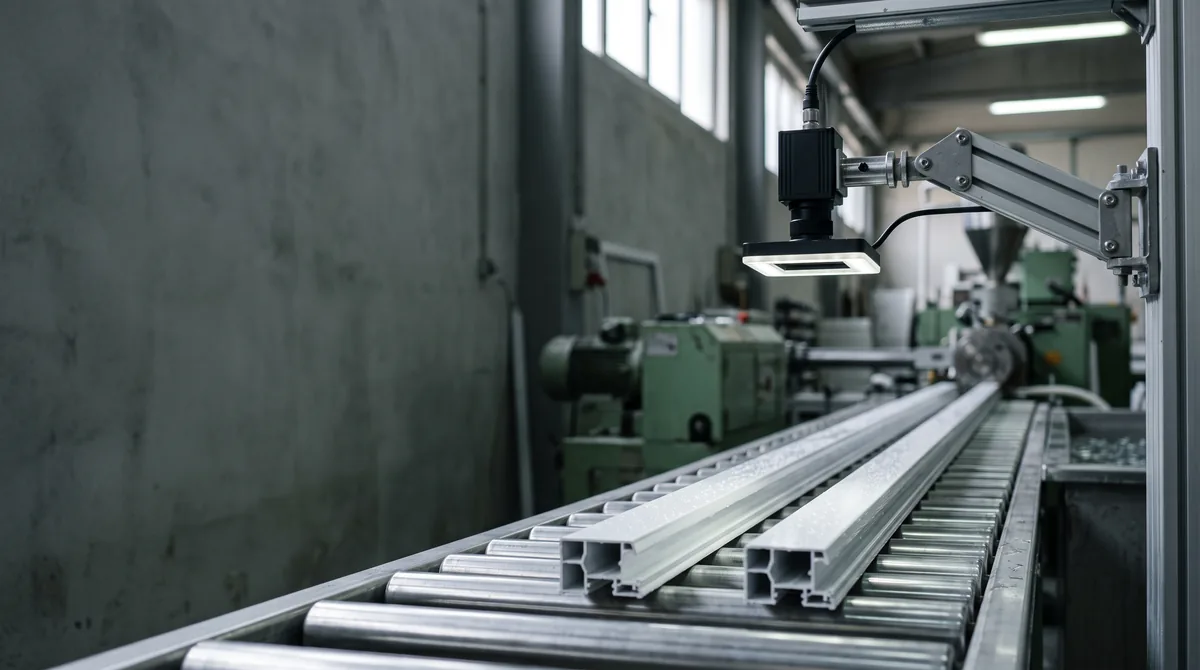
Inspection camera with a square LED light, pointing straight down over a roller conveyor carrying white PVC profiles.unsure 0.64 · to a humanThis image was created with an AI tool (AI Act, Article 50).

AI use in firms with 10+ staff, 2025: in rubber, plastics and non-metallic minerals, Greece 12.67% and EU 16.77%; in food, drink and tobacco, Greece 3.84% and EU 12.47%. Source: Eurostat.

Enterprises with 10+ staff, 2025. source (opens in a new tab)Eurostat, AI use by sector (isoc_eb_ain2), 2025 Figures from an official statistics body, with the year shown.

The first category counts cement, glass and ceramics alongside plastics (NACE C22–C23).

OKsink mark 0.94OKOKflash 0.91OKunsure 0.64 · to a humanOKblack speck 0.88OKshort shot 0.97OK
Parts inspected
12
Rejected
4
Sent to a human
1
A typical example of what the model sees and does.

The invisible problem

Your inspector is good. And human.

At 07:00 they look at every part. By 14:00 they look at whatever they can, because the line has sped up and the palletising is theirs too. The defects that slip through show up nowhere in production. They show up weeks later: in a credit note, a returned pallet, a buyer's email that opens with “Unfortunately”.

The cost scatters. A little in scrap, a little in re-inspection hours, a little in the discount the salesperson gives to keep the customer. No spreadsheet adds it up under the name “quality”.

If you sell to retail chains or large manufacturers, an escaped defect doesn't just cost a credit note. It costs your place on their supplier list.

07:0010:0014:00

How it works on your floor

From camera to reject gate.

  1. 1

    What you already have

    Often there is already an IP camera over the line. If not, an industrial camera and proper lighting: the lighting matters as much as the camera. We take the image over RTSP or GigE Vision, and a signal from the PLC for the moment each part passes.

    IP camera · RTSP · GigE Vision · PLC trigger

  2. 2

    The model

    We train it on photos from your own line: good parts, and the defects that cost you. It runs locally, on a computer beside the line, so the decision lands within the cycle time and the image never has to leave the plant.

    trained on your samples · runs on site

  3. 3 The decision, inside your system

    Three paths, one record

    “OK” and the part carries on. “Reject” and the PLC fires the reject mechanism. “Not sure” and the part goes to a human review queue, with its photo alongside. Every decision is logged with image, time and lot, and the quality lead sees it in the ERP or on the shift screen.

    OK · reject · human review · ERP

Three-step diagram: a camera and light over the conveyor, a computer beside the line, and a fork where good parts continue, defective ones are rejected and uncertain ones go to a person.

Hardware: one camera and one light per inspection point, one computer beside the line. Often the camera is already there. We take care of the data, the models, the dashboards and the alerts.

What we measure

We measure what hurts your customer.

The formulas are the same for everyone. The values are yours, measured before the pilot.

  1. Escaped defects (ppm)

    The formula defects found by the customer ÷ parts delivered × 1,000,000

    We measure it in the baseline period. We don't show a number we haven't measured.
  2. Scrap (%)

    The formula parts rejected ÷ parts produced × 100

    We measure it in the baseline period. We don't show a number we haven't measured.
  3. Inspection hours

    The formula human inspection hours + re-inspection hours, per shift

    We measure it in the baseline period. We don't show a number we haven't measured.
  4. Quality credit notes (€)

    The formula Σ credit notes and returns marked “quality”, per month

    We measure it in the baseline period. We don't show a number we haven't measured.

The model's own marks

  1. Missed defects

    The formula defective parts passed as OK ÷ all defective parts

    We measure it in the baseline period. We don't show a number we haven't measured.
  2. False rejects

    The formula good parts rejected ÷ all good parts

    We measure it in the baseline period. We don't show a number we haven't measured.

We publish these two in the pilot report, not a bare “accuracy”. A model that rejects everything misses no defects. It also ships nothing.

How the benefit is worked out

Monthly benefit = (ppm before − ppm after) × parts per month ÷ 1,000,000 × cost per escape + inspection hours returned × €/⁠hour − running cost

Payback (months) = pilot cost ÷ (monthly benefit − monthly running cost)

€/hour: default €18.20 (Eurostat 2025, manufacturing). We replace it with your own. source (opens in a new tab)Eurostat, labour cost levels (lc_lci_lev), 2025 Figures from an official statistics body, with the year shown.

The hours returned don't become redundancies. The inspector moves from “look at everything” to “judge the hard cases and find the cause”.

The pilot

6–⁠8 weeks. One line.

If the target isn't met, the report says so, with the same numbers we would have shown if it had been.

Before any of this, send us 20 photos from your phone. We tell you, free of charge, whether the defect shows up on camera and what lighting it would take. Send us 20 photos of a defect

NTX-PL-VQ6–⁠8 weeks

Pilot charter

Scope
One inspection point on one line or one mould family. The 2–⁠4 defect types that cost the most. An “OK, reject or human review” decision.
Duration
6–⁠8 weeks
Phases
  1. Weeks 1–⁠2Lighting, camera position, samples collected and labelled with your quality lead.
  2. Weeks 3–⁠5Training, then a shadow run beside your inspector: the model decides, nobody acts on it yet.
  3. Weeks 6–⁠8Live running with a human review queue. Escaped ppm, scrap, missed defects and false rejects measured. Decision.
Target
Example target: during the shadow run, the model catches at least as many defects as your experienced inspector, with false rejects below the limit your quality lead sets. An example target. Yours is set from your own baseline.
Cost
It starts with a Plant X-Ray, from €4,900, which includes a camera feasibility test on one line and is credited in full against the pilot.

Signed before any code is written.

Evidence

Play first. Read second.

  1. Try it yourself

    60 seconds, an AI-made image of a bottling line, eight defects. Then see what the machine found.

    Play “Spot the defect”

  2. 1 defect type · 340 images

    That was the whole scope of a 2024 lab study on injection-moulded parts: one defect type (burrs at a hole), 340 test images, one plant. It reports accuracy close to 100%. We don't show that as proof: real lines have glare, dust and hurry. That's why we measure on yours.

    source (opens in a new tab)Avestia MVML 2024, lab study A published scientific study. Avestia MVML 2024, lab study

  3. 12.67% · 16.77%

    of firms with 10+ staff in rubber, plastics and non-metallic minerals (cement, glass, ceramics) use AI, in Greece and the EU (2025).

    source (opens in a new tab)Eurostat, AI use by sector (isoc_eb_ain2), 2025 Figures from an official statistics body, with the year shown.

  4. 3.84% · 12.47%

    of firms with 10+ staff in food, drink and tobacco use AI, in Greece and the EU (2025). In 2024 Greece stood at 9.75%, above the EU: in small samples the share swings a lot from year to year.

    source (opens in a new tab)Eurostat, AI use by sector (isoc_eb_ain2), 2025 Figures from an official statistics body, with the year shown.

Our own measured project

We haven't published a measured vision project yet. The first one could be on your line.

Honest limits

Where it gets it wrong. And what we do about it.

Every vision model makes two kinds of mistake: it rejects good parts and lets bad ones through. We don't hide them. We tune them, and we measure them in front of you.

Show one of the model's mistakes and how we handle it

One of its mistakes, in fullA typical mistake of this kind, and how it is handled.

What the model said
The model saw a crack, at 0.62 confidence.
What actually happened
It was a reflection of the ceiling light.
What happened next
Below the 0.80 threshold, the part went to human review. The inspector passed it as OK, the photo joined the retraining set and a diffuser went on the light. The mistake was counted in that week's false rejects.
  • A confidence threshold: below it, a person decides.
  • A human review queue for the grey zone, with the photo alongside.
  • A record for every decision: image, time, lot, confidence.
  • Retraining whenever the material, mould, lighting or supplier changes.

What it needs from you

  • Samples: a few dozen to a few hundred photos per defect type, depending on how visible it is. We collect them together during the pilot. An estimate, given as a range. We confirm it in the X-Ray.
  • A fixed part position, or a known conveyor speed.
  • A quality lead who decides what counts as a defect. The model learns their criteria, not ours.

What it won't do

  • It can't see what a camera can't: internal stresses, dimensions below its resolution, smell, taste.
  • It doesn't replace the lab tests or dimensional checks your customer requires.
  • It doesn't promise 100%. No vision system achieves it, and whoever promises it has never stood beside a line at 14:00.

Play

One inspector, one camera, one shift.

The belt runs at line speed. Choose who's watching.

How it works in a typical plant.

Fully playable by keyboard.

Skip the demo: read how it works
Line speed
Parts
Defects caught
Defects missed
Sent to a human

Out of 150 parts, the inspector caught 1 of 6 defects. The camera caught 4, missed 1 and sent 4 to a person.

The line doesn't slow down at hour seven. Neither should the inspection.

Use case: here the “inspector” looks at one part in fifty, a rate set for this example. The camera makes mistakes too, as every camera does.

In the demo, a conveyor carries plastic parts at line speed. With the “inspector at hour seven”, one part in fifty is checked, so most defects pass unnoticed. With “AI on every part”, every part gets a box and a decision; most defects are caught, one slips through, and the uncertain ones go to a person.

What you just saw

Mechanism
The same attention on every part; a person only in the grey zone.
Why it works
Fatigue isn't negligence. It's biology. The camera doesn't tire, but light can fool it. That's what the review queue is for.
Data it needs
Photos of good and defective parts from your line, a PLC trigger, your quality lead's criteria.
Honest range
How much a model catches on your line we measure in the shadow run, beside your inspector. Not before.

Send us 20 photos of a defect

From your phone, as they are. Ideally ten showing the defect and ten good parts. We tell you whether the defect shows up on camera and what lighting it would need. No charge, no commitment.

We don't use them to train anyone else's models. We don't show them to anyone.

NTX-QCUp to 20 files · JPG, PNG or HEIC · up to 10 MB each

Up to 20 files · JPG, PNG or HEIC · up to 10 MB each

0 of 20 photos

    e.g. PP caps, olive oil bottles, steel brackets

    Same logic, another trade

    Every trade has its own defect.

    Same mechanism: a camera, a model trained on your samples, a person in the grey zone. Six lines where it works.

    Use cases: the same mechanism at work in other trades.

    Honey packer, Crete

    The jar with the wrong lot, bound for Germany

    What nobody sees
    A lid not screwed fully down, a label two millimetres off, a lot code that doesn't match the order. The buyer abroad spots it at goods-in and charges for it.
    What the AI does
    A camera after the labeller: lid, tamper seal, label position, lot and date read on every jar and checked against the order in the ERP.
    What we'd measure
    Rejections at customer goods-in · rejected jars % · inspection minutes per pallet

    The scenario goes into the X-Ray form. Nothing goes into the page address.

    Tomato packhouse, Ierapetra

    Grading that drifts with fatigue

    What nobody sees
    Class grading is done by eye, on a belt that never stops. In the morning “Extra” is strict; by the afternoon, less so. The difference shows up in returns from the supermarket chain.
    What the AI does
    A camera over the belt: colour, size, surface blemishes, a suggested class. The grader keeps the final call on borderline fruit.
    What we'd measure
    Customer returns · morning vs afternoon grading drift · tonnes per hour

    The scenario goes into the X-Ray form. Nothing goes into the page address.

    Rusk bakery, Rethymno

    The broken rusk in the pack

    What nobody sees
    Broken, over-baked or pale pieces reach the packing line, because nobody can look at every tray that leaves the oven.
    What the AI does
    A camera at the oven exit: bake colour, breakage, shape. Problem trays are flagged before packing, and the oven team is alerted when the colour starts to drift.
    What we'd measure
    Customer complaints · scrap % · colour drift per shift

    The scenario goes into the X-Ray form. Nothing goes into the page address.

    Steel fabricator, Volos

    The missing hole, found on site

    What nobody sees
    A hole that was never drilled, or a weld seam with porosity, shows up after the part is painted and loaded. The fix happens on the customer's site, with a crew and a delay.
    What the AI does
    Every part photographed before painting and compared with the drawing: holes, main dimensions, visible weld defects. Anything off goes to the quality lead.
    What we'd measure
    Site call-outs · rework · pre-paint inspection hours

    The scenario goes into the X-Ray form. Nothing goes into the page address.

    Dairy, Larissa

    The lid that didn't seal

    What nobody sees
    A yoghurt pot with an imperfect seal or an unreadable use-by date looks like a small problem. Until the chain finds it on the shelf and sends back the whole lot.
    What the AI does
    A camera after sealing: the seal as seen from above, lid position, date and lot read on every pot.
    What we'd measure
    Lot returns · rejected pots % · labelling checks per shift

    The scenario goes into the X-Ray form. Nothing goes into the page address.

    3PL warehouse, port of Volos

    The damage nobody remembers happening

    What nobody sees
    A pallet or container turns up damaged. Was it like that on arrival, or did it happen inside? Without a photo, the dispute with the customer drags on for weeks and the warehouse usually pays.
    What the AI does
    Cameras at the gate and the docks: a photo at every in and out, visible damage flagged, container and seal numbers read, linked to the WMS record.
    What we'd measure
    Damage claims (€) · time to settle a dispute · minutes per receipt

    The scenario goes into the X-Ray form. Nothing goes into the page address.

    Questions

    Can we use the cameras we already have?

    Sometimes. A security camera is enough for coarse checks: whether the part is there, whether it's in position, how many went by. Small defects need an industrial camera and controlled lighting. We know which before you buy anything, from your 20 photos and the X-Ray's camera test.

    How many defect photos do you need?

    To tell you whether it's feasible, 20 phone photos. To train the model, a few dozen to a few hundred per defect type, depending on how visible it is. We gather those together in the first weeks of the pilot, with the camera in place.

    What happens when the model isn't sure?

    It doesn't guess. Below a confidence threshold you set, the part goes to a human review queue with its photo alongside. The inspector's decision is logged and, where useful, becomes a retraining sample. That's how the grey zone shrinks over time.

    Will it replace our inspectors?

    No. It takes them off looking at every single part and gives them the work a camera can't do: judging the hard cases, finding why the defect appeared, and stopping it at the source. The hours that come back go where you need them.

    Where does it run, and where do the images go?

    The model runs on a computer beside the line, inside your plant. The images stay there, unless we agree in writing to keep samples for retraining, on EU-based infrastructure. We never use them for other clients' models.

    What does it cost?

    The 20-photo check is free. The Plant X-Ray starts from €4,900, includes a camera test on one line and is credited in full against the pilot.

    Next step

    Show us the defect that costs you.

    Twenty phone photos are enough to know whether it shows up on camera. Then the Plant X-Ray puts a number on what it costs and tests a camera on your line.

    • From €4,900 · 10 working days at your plant
    • Credited in full against a pilot signed within 60 days.

    We sit your plant's safety induction before we set foot on the line.