

Workflow X-Ray · fixed-price diagnosis
Workflow X-Ray: the diagnosis before the AI
Show us one working day.
We'll show you which three hours of it don't need to be human.
We come to your office, warehouse or line with a stopwatch. We measure every step in minutes, errors and euros. Two weeks later you're holding a map of the hours that leak, five opportunities with the payback worked out, and a demo running on your own documents.
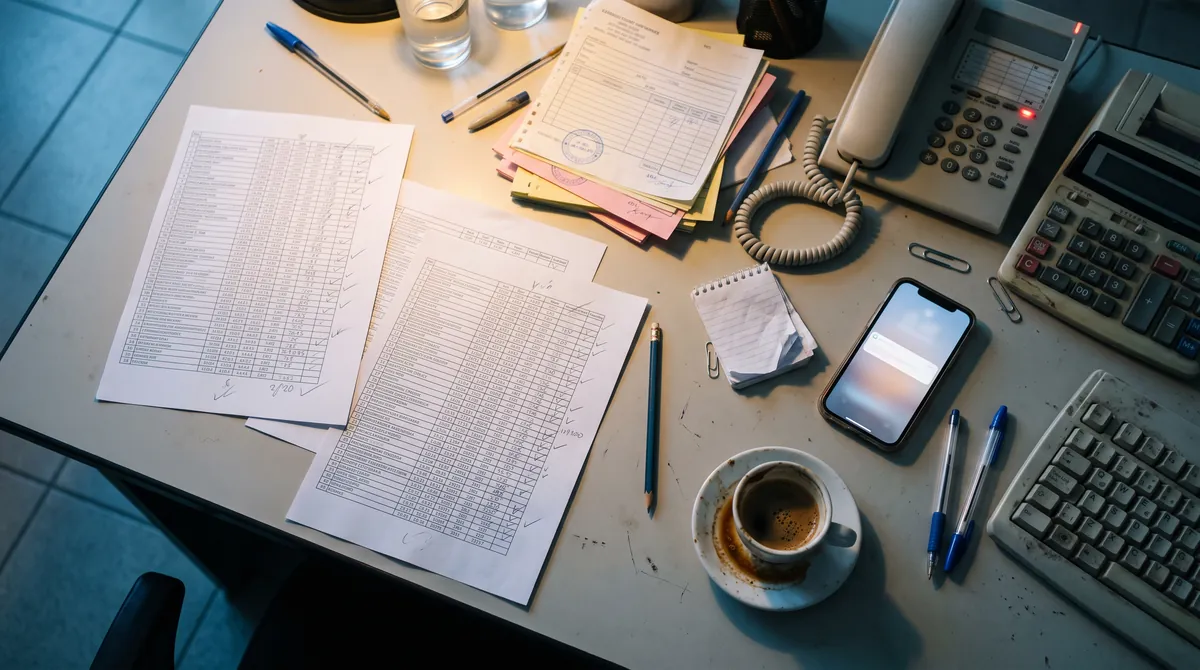
- two spreadsheets that disagree
- 6 min × 900 a month
- 'ask Nikos'
- waiting for sign-off
- missed call · 15:01
- retyping
How we got this number
- 90 hours of retyping (6 min × 900)
- 22 hours reconciling two spreadsheets (1 hour × 22 working days)
- 16.5 hours of 'ask Nikos' interruptions (15 × 3 min × 22)
Definition
Workflow X-Ray in Greek: Ακτινογραφία Ροών · noun
A Workflow X-Ray is a fixed-price diagnosis, one to two weeks long, that maps how work really moves through a business, measures the hours, errors and cost at every step, and ends with five automation opportunities with the payback calculated, plus a live demo on your own data.
It isn't a questionnaire, and it isn't a tool demo. We don't ask how your process works; we read it from your data: the timestamps on your ERP documents, your inbox, a stopwatch beside the desk.
Sometimes the best opportunity isn't AI at all: it's two systems that finally talk to each other, or a step that can simply go. We'll tell you that too.
Why diagnose first
You're not short of AI. You're short of a map.
-
≈79%
of Greek firms with 10+ staff have never even considered using AI. Across the EU: ≈68%.
Eurostat isoc_eb_ai, 2025 · our analysis
-
54.3%
of those who considered AI and didn't go ahead were stopped by cost. Across the EU, just 38.2%.
Eurostat isoc_eb_ai, 2025, firms with 10+ staff · our analysis
-
36% · 28% · 19%
of SMEs not using AI are waiting, respectively, for ready-made applications, incentives or proof.
National Bank of Greece SME survey, H1 2026 · bank survey
The X-Ray answers each of these: a fixed price instead of an open tab, a demo on your own data instead of promises, and a funding annex that tells you which programme fits, if any does.
Day by day
Ten working days, from stopwatch to demo.
This is how the standard X-Ray runs. The days follow your team's schedule, not ours.
Workflow X-Ray
-
Day 1
Kick-off and a first walk
Half a day with the owner or GM: goals, the processes in scope, and who 'the people who know' are. Shadowing starts that afternoon.
A list of processes and people
-
Days 2–3
Stopwatch and photos
We sit beside the people who do the work. We time each step, photograph the paper on the desks and, only with their consent, record the screen.
Step-by-step timings
-
Day 4
Document and data census
Which documents arrive, how many and from where. ERP exports, call logs, email and Viber metadata: when, from whom, how many. Not the content.
Document census
-
Days 5–6
The process as it runs, not as it's described
From the ERP timestamps (order, delivery note, invoice) we rebuild the flow and see where it waits, where it loops back and where it gets retyped.
Heat-mapped process map
-
Day 7
Numbers and opportunities
Every step gets hours, euros and an error rate. Every opportunity is scored on value, feasibility and time to value.
Hours-Leak Map, first draft
-
Days 8–9
The demo
We build a small demo on your own material: your invoices, your customers' questions, photos of your line.
A working demo
-
Day 10
Readout
With the owner or GM and the CFO: the numbers, the demo, a 90-day roadmap, funding. Whether to run a pilot is your call.
The five deliverables
X-Ray Compact
-
Day 1
Site visit
One process, one visit: stopwatch, photos, a conversation with the people who run it.
Timings
-
Days 2–3
Remote analysis
Exports and document samples; hours and euros per step.
A one-process map
-
Day 4
Demo
A small demo on that process's own material.
Demo
-
Day 5
Readout
The top three opportunities, with payback.
Three opportunities
From your team we need a few hours with each role we shadow, one kick-off meeting and one readout with management. You don't need to prepare anything.
What you get
Five deliverables that stay with you.
Whatever you decide next.
-
NTX-XR-01
Hours-Leak Map
Every process with hours a month, euros a year, error rate and automation potential.
-
NTX-XR-02
The top five opportunities
Ranked by value, feasibility and time to value. For each: return, months to payback, risk. Compact gives you the top three.
-
NTX-XR-03
A live demo on your own material
For example: 20 of your real invoices posted automatically, your customers' common questions answered by a voice agent, or defects marked on photos of your own line.
-
NTX-XR-04
A 90-day roadmap, funding annex and checklist
What comes first, what comes second, and who does it. Which programme could cover which line, subject to the current call text. And what the AI Act, GDPR and security require for everything we propose.
-
NTX-XR-05
A readout for the decision-makers
With the owner or GM, and the CFO. You leave with numbers, not slides full of arrows.
NTX-XR-01 · Hours-Leak MapExample
Refrigeration and air-conditioning service company · 38 staff · Magnesia
| Process | Volume × time | Hours/month | €/year | Errors | Potential | First move |
|---|---|---|---|---|---|---|
| Paper work orders typed into the ERP | 720 × 8 min, plus 144 calls × 10 min | 120 | €26,208 | 1 in 5 incomplete | High | Technician's voice note → work order in the ERP |
| Parts suppliers' invoices | 450 × 5 min | 37.5 | €8,190 | 4% with a price mismatch | High | Invoice read → ERP and myDATA |
| 'When's the technician coming?' calls | 900 × 3 min | 45 | €9,828 | 22% missed at peak | Medium | Viber updates from the technicians' schedule |
| The technicians' schedule, every morning | 1.5 hours × 22 | 33 | €7,207 | rebuilt twice a week | Medium | Suggested routes |
| Maintenance-contract renewals | 120 × 15 min | 30 | €6,552 | ≈ 1 in 10 forgotten | Medium | Reminders, approved by a person |
| Total | 265.5 hours/month · ≈ €57,985/year | |||||
Hours/month = volume × minutes per task ÷ 60 · €/year = hours/month × 12 × €18.20 (hourly labour cost 2025 in industry, construction and services, Eurostat)
You're already paying this cost. Part of it can be recovered; that's the part we work out in the opportunities, as a conservative range.
The X-ray archive
Every business runs a hidden factory.
It makes nothing. It retypes, searches, waits and corrects. Here's what it looks like in eight very different businesses, from an olive mill to a law firm.
The figures are examples, with the working shown on every film. Labour cost: €18.20/hour (industry, construction and services) or €16.00/hour in trade, Eurostat 2025. Yours will come from your own data. The term 'hidden factory' is Armand Feigenbaum's.
-

NTX · F01 · Olive mill · CreteUse case
Cooperative olive mill Crete · November–February season
- The scene
- In December the weighbridge ticket is written in biro. In March we're still typing it into Excel.
- What we time
- 6,000 olive deliveries a season: the weighbridge ticket and the acidity result typed in by hand, 5 minutes each. Then 900 producer statements at the end, 12 minutes each.
- Hidden load
- 680 hours a season · ≈ €12,400 ((500 + 180) hours × €18.20/hour, Eurostat)
- What the AI does
- Reads
- The demo at the readout
- Twenty of last season's weighbridge tickets, photographed on a phone, read and matched to the lab's acidity results while you watch.
- First pilot
- A photo of the ticket at the weighbridge → entry → the producer's statement drawn up automatically, plus a Viber message with kilos and acidity.
- What stays human
- The intake manager signs off every statement. The AI never changes a weight or a price.
- What we measure afterwards
- minutes per delivery · hours to settle the season · producer disputes
- Hours handed back
- ≈ 335–410 hours a season (5 min → 1.5 min per delivery · 12 min → 3 min per statement)Range: 70–85% of the theoretical saving, because not every task completes without a correction. The 'after' times already include human review.
-

NTX · F02 · Car rental · CreteUse case
Car rental Heraklion · 150 cars in summer
- The scene
- 'That scratch was already there,' says the customer. The paper diagram can't argue back.
- What we time
- 1,200 rentals a month in season, so 2,400 inspections (out and back), 6 minutes each with paper and pen. Three returns in a hundred end in a damage dispute, 45 minutes each.
- Hidden load
- 267 hours per peak month · ≈ €4,860 a month (€18.20/hour, Eurostat), before the damage nobody could prove
- What the AI does
- Sees
- The demo at the readout
- A 90-second walk-round video of three of your own cars, before and after a rental, with each new mark boxed and the model's confidence beside it.
- First pilot
- Phone video at handover and at return · a computer-vision comparison · time-stamped marks attached to the rental agreement.
- What stays human
- The agent confirms every mark with the customer. The AI never charges anyone.
- What we measure afterwards
- minutes per inspection · disputes per 100 returns · € of damage not recovered
- Hours handed back
- ≈ 120–150 hours per peak month (6 min → 2 min per inspection · 45 min → 15 min per dispute)Range: 70–85% of the theoretical saving, because not every task completes without a correction. The 'after' times already include human review.
-
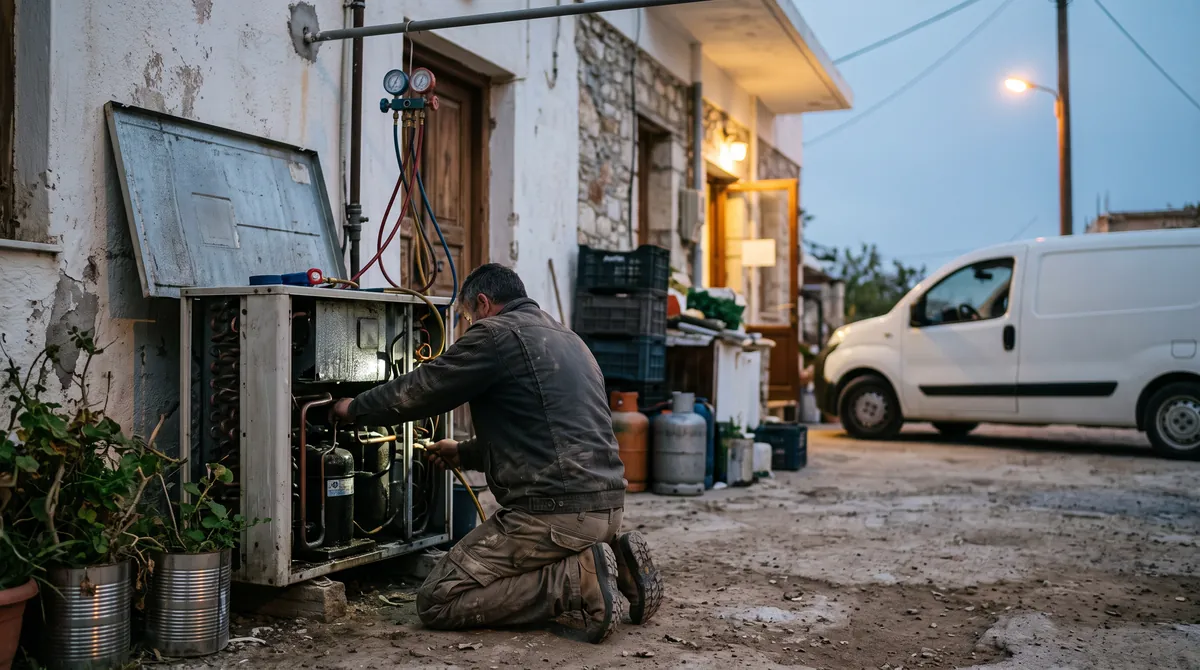
NTX · F03 · Field service · ThessalyUse case
Refrigeration and air-conditioning service Magnesia · 12 technicians on the road
- The scene
- The job is finished on Tuesday. The invoice goes out the Thursday after next, if someone finds the sheet.
- What we time
- 720 paper work orders a month, retyped into the ERP at 8 minutes each. One in five is incomplete, which means a call to the technician: another 10 minutes.
- Hidden load
- 120 hours a month · ≈ €26,200 a year (€18.20/hour, Eurostat), plus invoices that leave days late
- What the AI does
- Hears
- The demo at the readout
- Three of your technicians' voice notes, in Greek and with the traffic in the background, become complete work orders in your ERP.
- First pilot
- A 40-second voice note from the van · a photo of the unit's rating plate · a work order with parts and hours, ready to approve and invoice the same day.
- What stays human
- The technician confirms the parts. Accounts approves every invoice.
- What we measure afterwards
- days from job to invoice · office minutes per work order · incomplete orders
- Hours handed back
- ≈ 63–76 hours a month (8 min → 2 min per order, review included · incomplete orders from 1 in 5 to 1 in 20)Range: 70–85% of the theoretical saving, because not every task completes without a correction. The 'after' times already include human review.
-
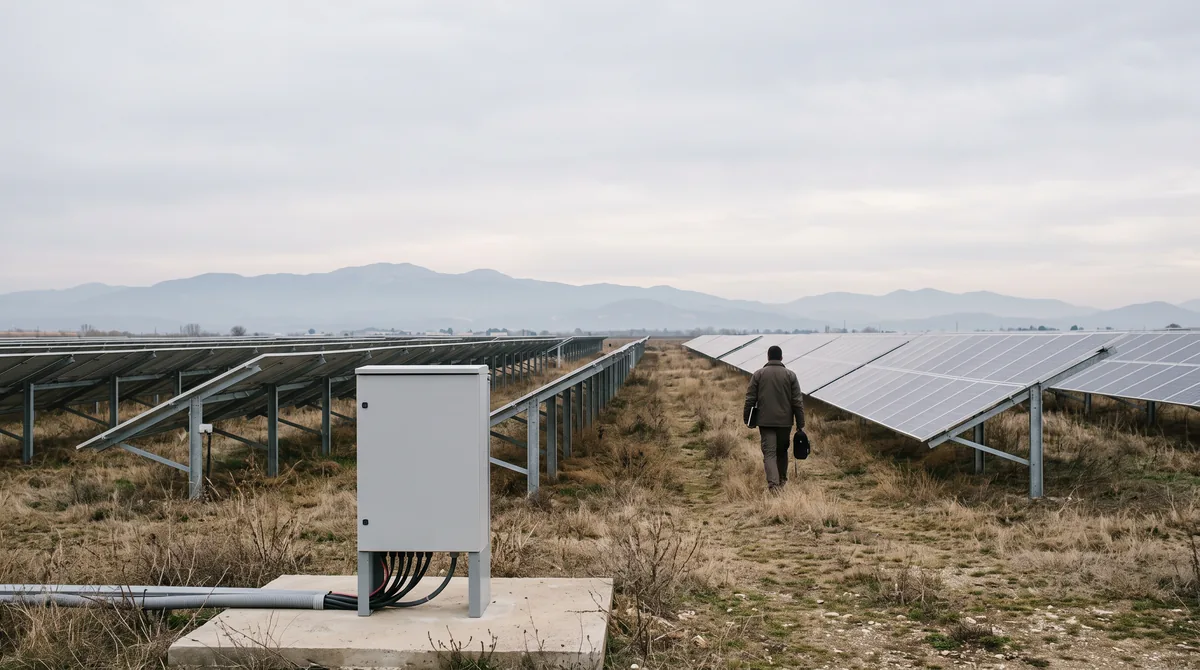
NTX · F04 · Solar O&M · ThessalyUse case
Solar park operations and maintenance Thessaly · 40 small parks
- The scene
- String 7 went down on 3 August. We saw it in the September report.
- What we time
- Every morning, 1.5 hours across four inverter portals from different makers. A monthly report for every park, an hour each. Six site trips a month that turned out to be unnecessary, four hours each.
- Hidden load
- 97 hours a month · ≈ €21,200 a year (€18.20/hour, Eurostat). Lost kWh are counted separately, at your own tariff.
- What the AI does
- Predicts
- The demo at the readout
- One month of your own inverter data in a single chart: every string compared with its neighbours and with irradiance, and the outliers ranked.
- First pilot
- A morning anomaly list across every park (soiling, string, inverter) · the monthly report written automatically · an alert before a loss turns into a month.
- What stays human
- The engineer decides who drives out. The AI doesn't touch a breaker.
- What we measure afterwards
- hours to detect a fault · kWh lost · trips with no fault found · performance ratio
- Hours handed back
- ≈ 48–58 hours a month (morning checks 33 → 8 hours · reports 40 → 8 hours · wasted trips halved)Range: 70–85% of the theoretical saving, because not every task completes without a correction. The 'after' times already include human review.
-
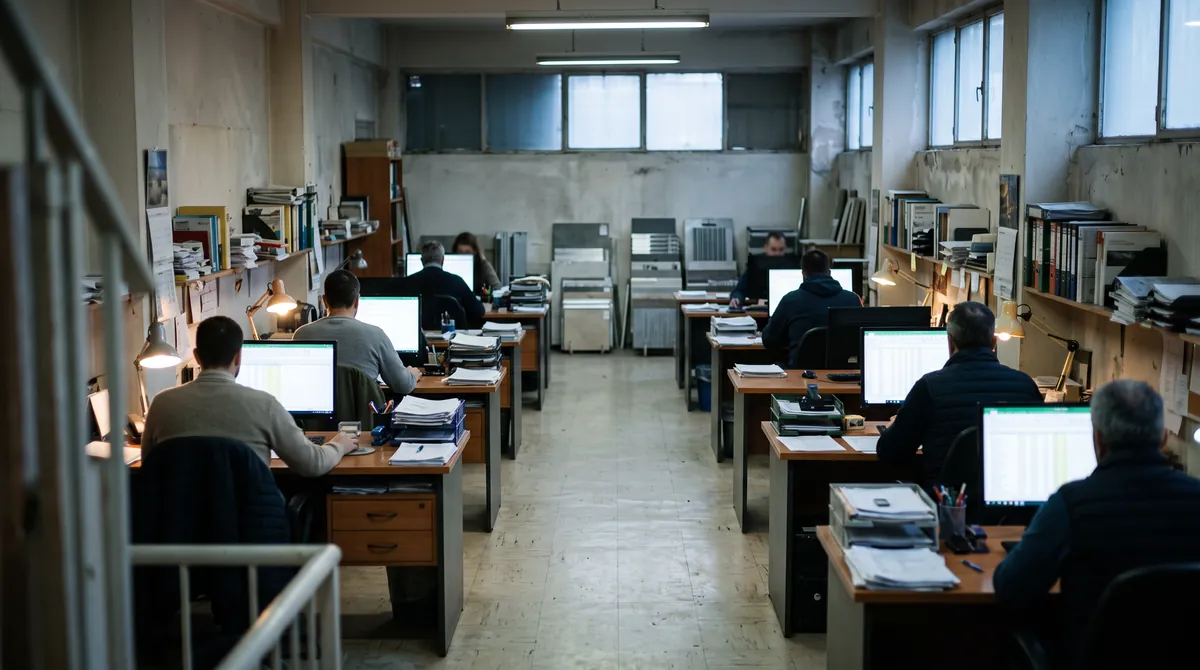
NTX · F05 · Building materials · ThessalyUse case
Building-materials merchant Magnesia · five delivery trucks
- The scene
- The contractor sends a photo of a handwritten bill of quantities. He wants a price by noon.
- What we time
- 176 quotes a month from bills of quantities sent as PDF, spreadsheet or photo; a salesperson matches every line to a product code and a price, 45 minutes each. Every morning, an hour to split the deliveries across the trucks.
- Hidden load
- 154 hours a month · ≈ €29,600 a year (€16.00/hour, trade, Eurostat)
- What the AI does
- Optimises
- The demo at the readout
- Ten of last month's bills of quantities turned into quotes with your own product codes and prices. Any line it isn't sure about is flagged for a person to check.
- First pilot
- Read the bill of quantities → match the codes → a draft quote from the ERP price list · a loading and route plan for the next day.
- What stays human
- The salesperson checks the uncertain lines and decides any discount. The AI never quotes off the price list.
- What we measure afterwards
- minutes per quote · time to respond · quote win rate · kilometres per delivery
- Hours handed back
- ≈ 83–100 hours a month (45 min → 10 min per quote · 1 hour → 15 min for the delivery plan)Range: 70–85% of the theoretical saving, because not every task completes without a correction. The 'after' times already include human review.
-

NTX · F06 · Tutoring centre · ThessalyUse case
Tutoring centre Larissa · 300 students
- The scene
- At 21:30 a mother asks on Viber whether Thursday's class has moved. The owner answers, from his own phone.
- What we time
- 600 parent messages a month (absences, timetable, instalments), 3 minutes each. A monthly progress note for 300 students, 6 minutes each, written by the teachers.
- Hidden load
- 60 hours a month · ≈ €13,100 a year (€18.20/hour, Eurostat)
- What the AI does
- Creates
- The demo at the readout
- A Viber assistant answers timetable questions from your own schedule, and a teacher's three bullet points become a draft note to the parent, ready to edit and sign.
- First pilot
- A Viber assistant that says it's AI in its first message · automatic absence alerts · draft progress notes.
- What stays human
- The teacher writes and signs the assessment. The AI never grades a student.
- What we measure afterwards
- time to first reply · messages answered without a person · teacher hours spent on admin
- Hours handed back
- ≈ 28–34 hours a month (3 min → 1 min per message on average · 6 min → 2 min per note)Range: 70–85% of the theoretical saving, because not every task completes without a correction. The 'after' times already include human review.
-

NTX · F07 · Insurance broker · CreteUse case
Insurance brokerage Heraklion · four people, 3,000 policies
- The scene
- One car-insurance quote means typing the same tax number into five insurers' platforms.
- What we time
- 120 quote requests a month, the same details entered on five platforms at 6 minutes each. 250 renewals a month, each with a reminder and a new quote, 10 minutes each.
- Hidden load
- ≈ 102 hours a month · ≈ €22,200 a year (€18.20/hour, Eurostat)
- What the AI does
- Decides
- The demo at the readout
- A customer's details go in once and are prepared for every insurer; the month's 250 renewals are put in order, with the ones most likely to lapse at the top.
- First pilot
- One customer form for every insurer, wherever their terms allow it · a prioritised renewals list · routine reminders on Viber.
- What stays human
- The adviser recommends the policy and talks to the customer. The AI doesn't price risk and doesn't turn anyone away.
- What we measure afterwards
- minutes per quote · renewals lost · time to respond
- Hours handed back
- ≈ 45–55 hours a month (30 min → 10 min per quote · 10 min → 4 min per renewal)Range: 70–85% of the theoretical saving, because not every task completes without a correction. The 'after' times already include human review.
-

NTX · F08 · Law firm · CreteUse case
Law firm Heraklion · five lawyers
- The scene
- The deadline runs from the date of service. The date of service lives in one folder on the secretary's desk.
- What we time
- 80 served documents and judgments a month; the secretary reads each one, works out the deadlines and enters them in the calendar, 12 minutes each. Every lawyer spends about three hours a week hunting for old briefs and drafts.
- Hidden load
- 81 hours a month · ≈ €17,700 a year at a conservative €18.20/hour (Eurostat); a lawyer's hour is worth more
- What the AI does
- Reads
- The demo at the readout
- Five of your served documents read, each deadline proposed with the provision it rests on, and entered in the calendar only once a lawyer confirms it.
- First pilot
- Documents read → deadline proposed → one-click confirmation · a search assistant over your own briefs, with access rights and EU hosting.
- What stays human
- A lawyer confirms every deadline. The AI gives no legal advice, and your documents train no model.
- What we measure afterwards
- minutes per document · deadlines confirmed in time · hours spent searching
- Hours handed back
- ≈ 26–32 hours a month (12 min → 3 min per document · 4 in 10 search hours)Range: 70–85% of the theoretical saving, because not every task completes without a correction. The 'after' times already include human review.
No films match this filter. Try another, or show them all.
Don't see your sector? The method doesn't change.
Book a 45-minute Scan callPrices
The same method, in four sizes.
Prices exclude VAT. We publish them because that's how we'd want to find them.
Prices · NTX-XRPrices exclude VAT.
-
Scan call
Price: Free
Book a Scan callWhat's includedLess
Ten questions on volumes, systems and whatever is eating your hours; we fill in the Hidden Cost Meter together. You leave with three candidate processes.
-
X-Ray Compact
Price: €890
Book CompactWhat's includedLess
One process mapped, hours and euros per step, the top three opportunities and a small demo.
-
Workflow X-Ray Recommended
Price: €1,900
Book an X-RayWhat's includedLess
On-site shadowing with a stopwatch, a document census, lightweight process mining from ERP timestamps and email and Viber metadata, conversations with 'the people who know'. The top five opportunities and a demo.
-
Plant X-Ray
Price: from €4,900
Request a plant visitWhat's includedLess
Everything above, plus energy and downtime data, quality logs and a camera feasibility test on one line.
The fee for every paid size is credited in full against a pilot signed within 60 days. Pilots start from €6,000.
The final Plant X-Ray price depends on lines, shifts and buildings. We put it in writing after the Scan call, before you commit.
-
Credited in full
Sign a pilot within 60 days of the readout and the whole X-Ray fee comes off the pilot's cost.
-
Confidentiality
We sign a non-disclosure agreement before we see your first document.
-
Minimum data, kept in the EU
We ask only for what the diagnosis needs. Processing stays inside the EU. After the readout we delete the data, unless we carry on together and you ask us to keep it.
Is it for us?
Ten signs. How many apply to you?
Tap the ones that apply. Your answers stay in your browser; nobody else sees them.
That's 0 of 10
None? We're envious. Or you haven't spotted them yet.
Funding
We don't sell grants. We tell you what fits.
Every X-Ray comes with a funding annex: which programme could cover which line of the plan, at what rate and by when, always subject to the current call text. If nothing fits, we say so.
None of our proposals depends on a grant. If a matching call opens, you'll already be ready.
| Programme | Status |
|---|---|
| Mass-market voucher for digital tools | None open at the moment. |
| €150M AI scheme for SMEs | Announced; the terms and the call date have not been published. |
| ESPA 'Advanced Digital Transformation of SMEs' | Closed to new applications; approved beneficiaries are still implementing, with the term extended to 31 months. |
| Thessaly 'Αναπτύσσομαι έξυπνα' grants (70%) | Applications closed on 31 March 2026. If your project was approved, the annex shows what it can cover. |
| Loans through the Hellenic Development Bank | Available; current terms checked case by case. |
For information, not legal or tax advice. The call text always prevails.
Before you book
Put a first number on it.
Three minutes, no more than four sliders per department. The formula sits under the result. The number is an estimate; the X-Ray measures it.
Hidden Cost MeterWork sheet
Department Accounts
- Documents per month
- 600
- Minutes per document
- 5 min
- Documents with an error or exception (%)
- 8%
- Minutes to fix each error
- 20 min
- Hourly labour cost
- €18.20/hour
Eurostat lc_lci_lev, 2025 · official statistics
- Hidden hours per month
- 66
- What could be automated
- People back on real work
- 0.22–0.31 full-time equivalentsWe don't count jobs cut. We count time given back.
- Payback against a pilot
- 10–21 months Against a typical pilot of €6,000 to €18,000.
What we'd build
- Document reading into the ERP and myDATA, with an approval queue
- Automatic matching of invoice, delivery note and order
- Cash-on-delivery and bank reconciliation
Funding. In the X-Ray we check which programme fits, if any does, against the current call text.
The formula
Hidden hours/month = (documents × minutes + documents × error % × fix minutes) ÷ 60
Cost/year = hidden hours/month × 12 × hourly cost (+ external cost, where there is one). Automatable = labour cost × department coefficient (0.50–0.70) + external cost × a second coefficient. People = hidden hours/month × coefficient ÷ 150 hours. Payback = pilot cost ÷ (automatable ÷ 12).
The coefficients are our own conservative estimate, shown here so you can challenge them. 150 hours is one person's productive time in a month (≈1,800 a year).
The form will already hold your numbers.
Questions
What people ask before they book.
How much does a Workflow X-Ray cost?
The 45-minute Scan call is free. X-Ray Compact costs €890, the standard X-Ray €1,900, and the Plant X-Ray starts from €4,900, all excluding VAT. If you sign a pilot within 60 days of the readout, the whole fee comes off the pilot's cost.
What do you need from us?
Access to the people who do the work, for a few hours each. ERP exports, sample documents and, where they exist, call logs. One kick-off meeting with management and one readout at the end. You don't need to prepare anything; we gather it ourselves, with your team.
Will you see sensitive data?
As little as possible. From email and Viber we read metadata (when, from whom, how many), not content, unless we agree in writing on specific samples. We sign an NDA, processing stays inside the EU, and we delete the data after the readout unless we carry on together.
What if you don't find anything?
Then you find out with numbers, and that's worth something: you know where not to invest. That's why we start with the free Scan call; if we don't see enough volume, we tell you before you pay.
Do we have to carry on with you?
No. The deliverables are yours: the Hours-Leak Map, the opportunities with their workings, the 90-day roadmap. You can build them with anyone you like, or on your own. If you carry on with us within 60 days, the whole fee is credited against the pilot.
How is this different from a free 'AI assessment'?
The X-Ray doesn't start from a tool that needs selling. It starts from your work: we time it, count volumes and errors, and sometimes recommend something that isn't AI at all, such as connecting two systems. You leave with numbers and a demo on your own data, not a quote for a chatbot.
Can it be done remotely?
X-Ray Compact is mostly remote, with one visit. The standard X-Ray needs us at the desk, because a stopwatch doesn't work over a video call. We have offices in Heraklion and inside the Almyros industrial area; for anywhere else, we'll talk it through on the Scan call.
Can it be funded?
It depends on which programme is open at the time. Every X-Ray includes a funding annex on what could cover the pilot and the rollout, subject to the current call text. We don't sell grants, and we never build a proposal that depends on one.
Book an X-Ray
We start from your working day.
Three steps, under two minutes. A person replies within one working day.
Not a fan of forms? Write to info@netex.gr.
Booking for a plant? The Plant X-Ray form also asks about lines and shifts.