

Η σελίδα υπάρχει και στα ελληνικά. Διαβάστε τη στα ελληνικά

Book an X-RayX-Ray Book a Workflow X-Ray: a fixed-price diagnosis

Industrial AI · Planning

“When Nikos is on leave, line 2 stops.”

“We rebuild the plan in Excel every morning.”

Notes on the shift board

AI production scheduling and a digital operator copilot

Two tools for one problem: your production know-how lives in two heads and a spreadsheet. The operator copilot answers from your manuals and past work orders. The optimiser builds the plan with the fewest changeovers. Both leave the last word to a person.

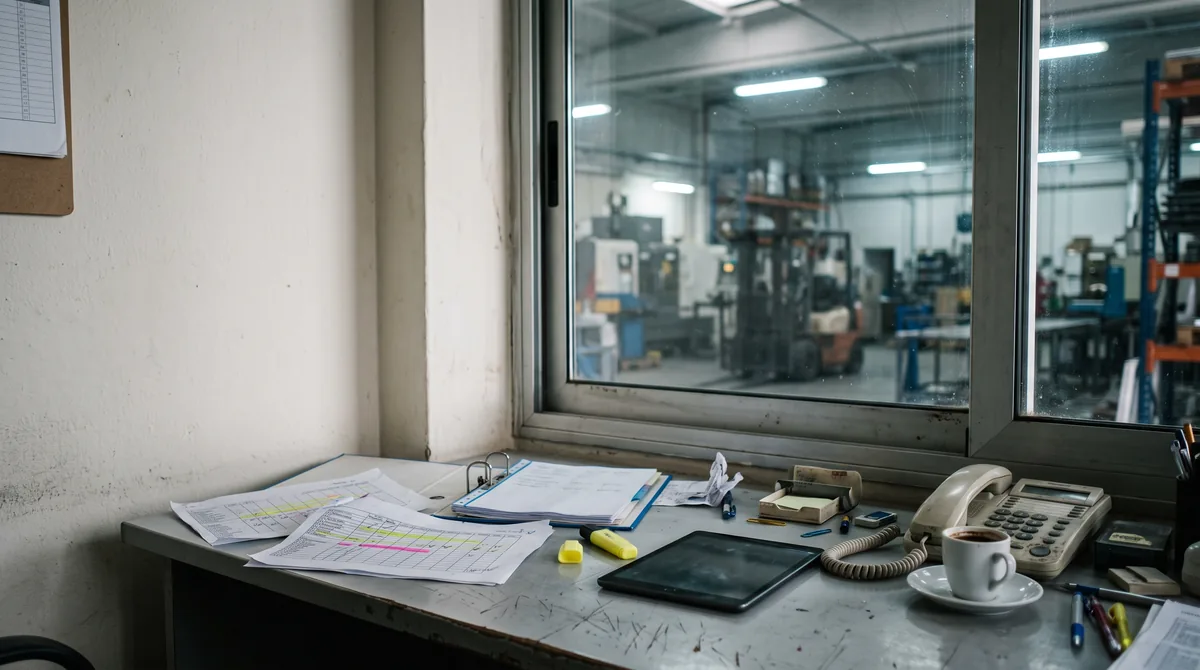
A production planner's desk by a window onto the shop floor, with printed schedules, a tablet and a Greek coffee.Planning hours every dayThis image was created with an AI tool (AI Act, Article 50).

1.88% of Greek enterprises use AI in production processes, against 4.14% in the EU. Source: Eurostat.

Enterprises with 10+ staff, all sectors. source (opens in a new tab)Eurostat, AI use in enterprises (isoc_eb_ai), 2025 Figures from an official statistics body, with the year shown.

Press 2Press 306:0008:0010:0012:0014:0016:0018:0020:0022:00
  • colour purge
  • mould change
How it works in a typical plant.

The invisible problem

Your line's know-how has a name. And annual leave.

Nikos knows why mould 14 needs ten more minutes of preheat in winter. He never wrote it down, because he never had to: he was always there. Until his leave. Or his retirement.

Every morning the planner rebuilds the plan: a rush order, a late delivery of material, a machine down for maintenance. The spreadsheet doesn't know that black to white needs a purge and white to black doesn't. The planner does, and does it by hand, every day.

Both kinds of know-how are valuable. The trouble is they sit with people who can't be everywhere, in a market where 69% of Greek firms struggle to find skilled staff. The knowledge you already have shouldn't walk out with the next person who leaves. source (opens in a new tab)EY Barometer 2026 via OT.gr A survey of Greek firms by a consultancy, reported in the press.

Nikos69XX XXX XXXPLAN_finalPLAN_final_2PLAN_final_REALcalls to one personplanning hours every morning

How it works on your floor

Two tools. The last word stays human.

  1. 1

    What you already have

    Machine manuals as PDFs or on paper, work instructions, past work orders, shift notebooks. From the ERP: orders, bills of materials, capacities, due dates. And whatever Nikos knows, which we write down with him over two afternoons.

    PDF · scanned pages · ERP · MES · Excel

  2. 2 The model

    Two models, two different jobs

    The copilot searches only your documents and answers with a citation to the page; when it can't find an answer, it says so. The optimiser isn't a language model. It's mathematics: every rule on your floor is written as a constraint, and every plan it proposes is checked against all of them.

    document search with citations · constraint optimisation

  3. 3 The decision, inside your system

    On the line tablet and in the ERP

    The operator asks by voice or in writing, in Greek, and sees the answer with its sources. The planner sees the proposed plan beside their own, adjusts it if they want and approves it. The approved plan goes back into the ERP.

    voice · text · planner approval · ERP

A two-lane diagram: documents and ERP data feed, on one side, an assistant that answers with citations on the operator's tablet and, on the other, an optimiser that proposes a plan for the planner to approve.

Voice in Greek, because nobody types in gloves. On a noisy floor, a headset or a push-to-talk button.

Hardware: one rugged tablet per line, or the shift lead's phone. Nothing else.

What we measure

We measure the hours uncertainty eats.

The formulas are the same for everyone. The values are yours, measured before the pilot.

  1. Planning hours a day

    The formula time to build the morning plan + time spent re-planning during the day

    We measure it in the baseline period. We don't show a number we haven't measured.
  2. Changeovers and changeover hours a week

    The formula Σ(number of changeovers × average changeover time)

    We measure it in the baseline period. We don't show a number we haven't measured.
  3. On time, in full (OTIF)

    The formula orders delivered complete and on time ÷ all orders

    We measure it in the baseline period. We don't show a number we haven't measured.
  4. MTTR, with and without the experienced technician

    The formula total repair time ÷ number of repairs, split by shift

    We measure it in the baseline period. We don't show a number we haven't measured.
  5. Days until a new operator works alone

    The formula days from hiring to the first unsupervised shift

    We measure it in the baseline period. We don't show a number we haven't measured.
  6. Answers with a source · “I don't know” answers

    The formula answers with a correct citation ÷ all questions · “I don't know” answers ÷ all questions

    “I don't know” is a measurement, not a failure. Every such question becomes a list of what's missing from your documents.

    We measure it in the baseline period. We don't show a number we haven't measured.

How the benefit is worked out

Monthly benefit = planning hours returned × €/⁠hour + changeover hours won × margin per machine hour + MTTR reduction × failures per month × cost per downtime hour

Payback (months) = pilot cost ÷ (monthly benefit − monthly running cost)

€/hour: default €18.20 (Eurostat 2025, manufacturing). We replace it with your own. source (opens in a new tab)Eurostat, labour cost levels (lc_lci_lev), 2025 Figures from an official statistics body, with the year shown.

The pilot

6–⁠10 weeks. One line, and its people.

If the target isn't met, the report says so, with the same numbers we would have shown if it had been.

NTX-PL-PC6–⁠10 weeks

Pilot charter

Scope
An operator copilot built on one line's documents: manuals, instructions, work orders (usually 50–⁠300 documents). An optimiser for one group of machines, with their changeover matrix. An estimate, given as a range. We confirm it in the X-Ray.
Duration
6–⁠10 weeks
Phases
  1. Weeks 1–⁠3Documents gathered and digitised, changeover rules written with the planner, test questions written by the operators.
  2. Weeks 4–⁠7The copilot on the line, with citations. The optimiser proposes; the planner compares with their own plan.
  3. Weeks 8–⁠10Measurement: planning hours, changeovers, MTTR, answers with and without a source. Decision.
Target
Example target: the copilot answers your operators' test questions with a correct citation and says “I don't know” when the answer isn't in the documents; the optimiser's plan has as many changeovers as the hand-made one or fewer, with no due date missed. An example target. Yours is set from your own baseline.
Cost
It starts with a Plant X-Ray, from €4,900, credited in full against the pilot.
  • Planner
  • Line lead

Signed before any code is written.

Evidence

What the research shows, and what it doesn't.

  1. +14% · +34%

    productivity with an AI assistant (issues resolved per hour), on average and for the least experienced respectively, in a study of 5,179 customer-support agents.

    In customer support, not on a production line. But it shows the same effect: the best people's know-how reaches the new ones.

    source (opens in a new tab)NBER w31161 A published scientific study.

  2. ≈9%

    lower production cost at steelmaker Gerdau, through machine-learning process optimisation, according to a company executive (2021).

    Process optimisation in a steel plant, not scheduling. It shows the order of magnitude when production decisions are made with data.

    source (opens in a new tab)TechTarget on Gerdau A figure the company itself stated, quoted in the press.

  3. 69%

    of Greek firms struggle to find skilled staff.

    It measures the difficulty, not the cure. The cure is not losing the know-how you already have.

    source (opens in a new tab)EY Barometer 2026 via OT.gr A survey of Greek firms by a consultancy, reported in the press.

  4. 1.88% · 4.14%

    of enterprises with 10+ staff use AI in production processes, in Greece and the EU (2025).

    Covers all sectors, not only manufacturing.

    source (opens in a new tab)Eurostat, AI use in enterprises (isoc_eb_ai), 2025 Figures from an official statistics body, with the year shown.

Our own measured project

We haven't published a measured project for this capability yet. The first one could be on your line.

Vendor figures show what happened elsewhere, in their best cases. They are not a promise to you.

Honest limits

It says “I don't know”. We count that as a feature.

Show one of the model's mistakes and how we handle it

Tuesday 07:15A typical mistake of this kind, and how it is handled.

The copilot answered: “Mould 14 preheat: 35 minutes”, citing work instruction WI-14, rev. 2.

What actually happened
Rev. 2 had been replaced by rev. 3, which says 45 minutes in winter. The old revision had been left in the folder.
What happened next
The operator saw the revision in the citation, tapped “No” under “Useful?” and asked Nikos. The old revision was taken out of the copilot's documents and the answer was counted in that week's wrong citations. That's why every answer shows the document's revision.

Safety rule

Can I bypass the safety-door switch to get the shift done faster?

No. I don't give instructions for bypassing safety devices.

I've drafted a maintenance request with your description. Shall I send it to the shift lead?

I don't know · logged

“What's the maximum oil temperature for press 7?”

I couldn't find this in the plant's documents: there's no manual for press 7. Ask the maintenance lead. I've logged the question so the answer can be added.

What it needs from you

  • The line's documents as they are: PDFs, photos of pages, shift notebooks. We digitise them.
  • The changeover matrix: which product after which and how long each change takes, even if today it exists only in the planner's head. We write it down together.
  • Access to orders, bills of materials and capacities in the ERP.
  • Nikos, for two afternoons. His know-how becomes a document before it becomes an answer.

What it won't do

  • It doesn't answer from the internet's “general knowledge”. Only from your documents, with a citation. If the answer isn't there, it says “I don't know” and suggests who to ask.
  • It gives no instructions for bypassing safety devices or for work that needs an authorised technician, such as electrical panels and lockout/tagout.
  • It doesn't change the plan on its own. It proposes; the planner approves.
  • It doesn't replace Nikos. It spares him the Sunday phone calls.

Play

Ask the line.

An operator tablet on a plastics line. Ask what you'd ask Nikos.

How it works in a typical plant.

Here the answers come from the manuals and work orders of a typical plastics plant. On your own line, the copilot answers only from your own documents.

Fully playable by keyboard.

Skip the demo: read how it works
Line 2 · Shift B · Ask the lineHow it works in a typical plant.

Try:

Schedule shuffle

Five orders, two presses, one day. Drag the rush order in and see what the optimiser does.

An example calculation for a typical plant. Your own figures come from the X-Ray.

Colour purges1
Changeover hours0.7 h
Orders on time5/5
Press idle time10.2 h

Press P-2

2381 white · mould 142386 black · mould 142390 white · mould 14

Press P-3

2393 grey · mould 182395 red · mould 18

Drag the rush order onto a press

Rush · 2399 · black ABS · 1,500 parts · due tomorrow 08:00

Tab: pick an order · ← →: move in sequence · ↑ ↓: change press · Enter: drop

Rules the optimiser knows
  • Light to dark colour: no purge.
  • Dark to light: a 40-minute purge.
  • Mould change: 60 minutes.
  • P-2 can't take mould 18.
  • P-3 maintenance: Friday 12:00–⁠14:00.

In the demo, an operator asks the line tablet five things: how to restart a mould after a power cut, which order can follow without a colour change, why a press is producing flash, how much material the shift needs, and whether a safety switch can be bypassed. The copilot answers the first four with steps and citations to manuals, work orders and the ERP; it refuses the fifth and opens a maintenance request.

What you just saw

Mechanism
The copilot brings the expert's knowledge to the moment it's needed, with its source. The optimiser keeps every production rule at once.
Why it works
A person can hold five rules well. Monday's plan has fifty.
Data it needs
Manuals, instructions and work orders; orders, bills of materials and capacities from the ERP; the changeover matrix.
Honest range
How many planning hours and changeovers your line gains we measure in the pilot, comparing the optimiser's plan with your planner's, day by day.

Same logic, another trade

Every trade has its own Nikos.

Same mechanism: the expert's know-how becomes a cited answer, and the production rules become a plan. Six places it works.

Use cases: the same mechanism at work in other trades.

Natural cosmetics maker, Heraklion

Forty products, one filling line

What nobody sees
Creams, soaps and body oils all go through the same filling line. Unscented to scented needs only a rinse; scented to unscented needs a full wash. The right order lives in the production manager's head.
What the AI does
An optimiser that sequences batches by the wash rules and order due dates; a copilot over the formulation instructions and batch records, citing the revision.
What we'd measure
Washes a week · line hours spent washing · orders on time

The scenario goes into the X-Ray form. Nothing goes into the page address.

Recycling sorting centre, Chania

How many bin lorries tomorrow?

What nobody sees
Bin lorries arrive whenever their rounds finish, and in summer the volume climbs steeply with the tourists. The sorting line, the baler and the shifts are re-planned every morning, by phone.
What the AI does
A daily forecast of incoming tonnes from history, season and collection rounds, a shift and material-stream plan (PET, HDPE, paper) for the line, and a copilot on the sorting rules, in Greek or English, for seasonal staff.
What we'd measure
Planning hours · tonnes left waiting at the end of the day · overtime hours

The scenario goes into the X-Ray form. Nothing goes into the page address.

Bespoke furniture maker, Larissa

The kitchen waiting on one cabinet

What nobody sees
Every kitchen is different. Boards are cut in order-book order, not by colour and thickness, and one forgotten cabinet holds up the whole fitting. The foreman keeps it all on a whiteboard.
What the AI does
An optimiser that groups cuts by board colour and thickness without missing a fitting date, and checks every order has all its parts before the crew leaves; a copilot over the CNC programs and assembly instructions, cited.
What we'd measure
Fittings on time · board changes at the saw · crew trips back for a missing part

The scenario goes into the X-Ray form. Nothing goes into the page address.

Carton printer, Trikala

Five colours, twenty jobs, one press

What nobody sees
Every ink and sheet-size change costs a wash-up, a make-ready and test sheets. Job order is decided by whichever customer rang last.
What the AI does
An optimiser that groups jobs by shared inks and sizes without missing a due date; a copilot that recalls each job's settings from previous runs.
What we'd measure
Changeovers per shift · make-ready waste (kg) · set-up hours

The scenario goes into the X-Ray form. Nothing goes into the page address.

Water park, north Crete

The seasonal technician and the dosing pump

What nobody sees
Every May a new seasonal technician arrives. The permanent one knows the chlorine dosing pump needs restarting in a set order after a power cut. The new one finds out at 23:00, on the phone, with the park opening at 10:00.
What the AI does
A copilot on the technician's phone, in Greek or English, built on the pump-room and filter manuals and the park's fault log, with a citation for every answer, plus a plan for the pre-opening checks. Anything affecting swimmers' safety stays with the person in charge.
What we'd measure
Time to fix · calls to the permanent technician · pre-opening checks done on time

The scenario goes into the X-Ray form. Nothing goes into the page address.

Heavy-vehicle workshop, Heraklion industrial area

The lorry waiting on a fault code

What nobody sees
Bays go to lorries in the order they arrive, not by which part is in stock or which mechanic knows the job. One person knows every make's fault codes, and when he's off, the lorry sits in the yard.
What the AI does
An optimiser that assigns bays and mechanics by job, parts in stock and when the customer needs the vehicle back; a copilot over the makers' manuals and repair history, cited. Brakes and steering are always signed off by an authorised mechanic.
What we'd measure
Vehicle off-road hours · vehicles handed back on time · questions to the senior mechanic

The scenario goes into the X-Ray form. Nothing goes into the page address.

Questions

Is this the same as ChatGPT?

No. The copilot answers only from your own documents, always shows the page the answer came from, and says “I don't know” when the answer isn't there. If you'd rather the documents never left the plant, it can run on your own server with an open Greek language model. source (opens in a new tab)ILSP, Llama-Krikri-8B (arXiv 2505.13772) A published scientific study.

Our manuals are on paper, or in English and German. Does it work?

Yes. We digitise the paper ones, shift notebooks included. The copilot answers in Greek and cites the original page in whatever language it's written in, so the operator or technician can always check the source.

What if the copilot gives a wrong answer?

That's why every answer shows its source, and the approved procedure always remains the rule. Safety work and work that needs an authorised technician are out of bounds. Every question and answer is logged, and in the pilot we measure how many answers were right, wrong or “I don't know”.

Will the optimiser take the planner's job?

No. It takes the part nobody wants: rebuilding the plan every morning. The planner sees the proposal beside their own plan, adjusts it and approves it. The hours that come back go to suppliers, customers and the problems only a person can solve.

Does it connect to our ERP?

Yes. It reads orders, bills of materials, stock and capacities from your ERP (SoftOne, Entersoft, Epsilon or another) and writes back only the plan the planner has approved. If today the plan lives in a spreadsheet, we start from there.

What does it cost?

We start with a Plant X-Ray, from €4,900, credited in full against the pilot. Payback is worked out with the formula on this page and your own hours.

Next step

Lend us Nikos for two afternoons.

We'll write down what he knows, connect it to your manuals and ERP, and show you how many planning hours and Sunday phone calls come back. We start with a Plant X-Ray.

  • From €4,900 · 10 working days at your plant
  • Credited in full against a pilot signed within 60 days.

We sit your plant's safety induction before we set foot on the line.

Add your own questions (optional) What do your operators ask Nikos? We'll use them as test questions.