

Web & Apps · E-shops
E-shops wired to your ERP, myDATA and couriers: Connected Commerce.
The order travels on its own.
An e-shop doesn't end at "thank you for your order". That's where the ERP, the invoice, the courier, the cash on delivery and the Skroutz stock begin. We connect them, so nobody types them again.
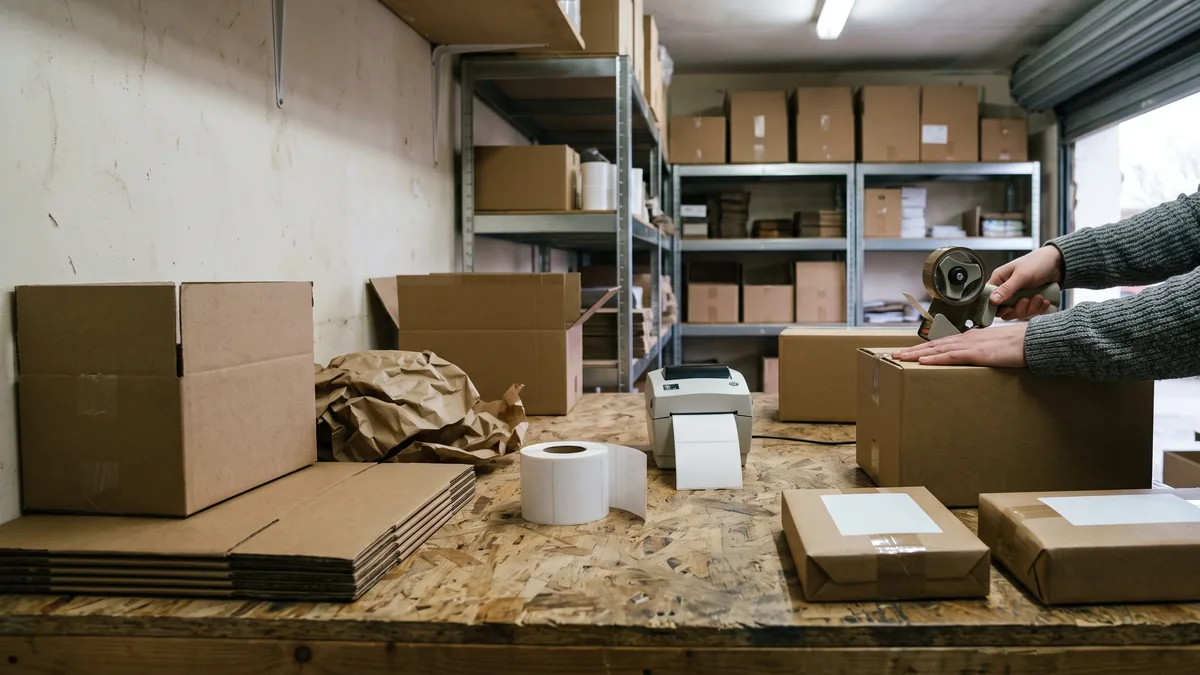
An order's journey
Seven stops. How many by hand?
Order
- Without connections
- It lands in WooCommerce. So far, so good.
- With connections
- It lands in WooCommerce and heads straight for the ERP.
ERP
- Without connections
- Someone retypes it into the ERP: customer, items, prices.
- With connections
- It's created in the ERP with the right codes. Shortfalls and price mismatches get flagged.
Invoice and myDATA
- Without connections
- It's issued by hand, then someone checks whether it reached myDATA.
- With connections
- It's issued from the ERP and transmitted through a certified provider, as invoices will require from 1 February 2027.
Courier
- Without connections
- The voucher is created on the courier's website, with the address and phone copied over by hand.
- With connections
- The voucher is created automatically and the tracking number comes back to the order.
Customer updates
- Without connections
- "Where's my order?" on the phone, five times a day.
- With connections
- The customer is updated without asking, and the AI assistant answers from the real shipment data.
Cash on delivery
- Without connections
- The courier's payout statement is checked line by line against a spreadsheet.
- With connections
- The payout statement is matched to the orders automatically. Differences go to a person.
Stock and Skroutz
- Without connections
- Stock gets updated "when we get round to it", and Skroutz shows something that's sold out.
- With connections
- ERP stock reaches the site and the Skroutz feed at every sync.
Left and right arrows move between stops.
What we connect
Make the systems you already pay for talk to each other.
- ERP
- Greek ERPs such as SoftOne, Entersoft and Epsilon, through their APIs: customers, items, prices, orders, invoices.
- E-invoicing
- Certified providers to myDATA, and the digital delivery note where it applies.
- Couriers
- Vouchers, tracking numbers, returns and cash-on-delivery statements from Greek couriers and parcel lockers.
- Marketplaces
- Feeds for Skroutz and BestPrice, with price and stock from the ERP.
- Payments
- Banks and payment providers, with payments reconciled against orders.
- CRM and email
- Customers and purchases in your CRM, for messages based on what people actually bought.
In the AI Readiness Index 2025, 80% of SMEs named ERP or CRM integration as a barrier.
AI Readiness Index 2025 (ENTERSOFTONE and AUEB ELTRUN) A survey co-authored by a company that sells software. Useful, but not neutral.
E-invoicing
The invoice is changing route.
According to AADE (30/9/2026), businesses with 2023 revenue up to €1 million must issue e-invoices from 2 November 2026, with a transition period until 31 January 2027. From 1 February 2027, documents reach myDATA only through a certified provider or AADE's own apps, no longer directly from an ERP.
For an e-shop, that means one more connection that has to run without a human hand: order, ERP, provider, myDATA.
according to AADE (30/9/2026) An announcement by a public authority, such as AADE, with its date.
The rule covers invoices. For retail receipts, we check what applies in your case.
Check your readiness in 2 minutesConversion
Ads bring people in. Checkout closes the sale.
We measure every step from product page to payment and fix first where the most people drop off. With A/B tests where traffic allows, with judgement and measurement where it doesn't.
Find where your funnel leaksCustomer service
It answers with the data, not with platitudes.
It answers "where's my order?" and "what size should I get?" from the real order and catalogue data. It says it's AI in its first sentence and hands over to a person in one tap.
See the AI Front DeskIn a study of 5,179 customer-support agents, an AI assistant raised the number of issues resolved per hour by 14% on average, and by 34% for the least experienced.
Accessibility
Accessible. And now, for most e-shops, mandatory.
The European Accessibility Act has covered e-commerce services since 28 June 2025, with an exemption for micro-enterprises that provide services. We build e-shops to a WCAG 2.2 AA target: full keyboard use, proper labels on forms and filters, visible focus, real text instead of pictures of text, and an accessibility statement that says what applies.
Directive (EU) 2019/882, European Accessibility Act The text of a law or regulation, linked to its official publication.
An e-shop is never finished. It needs looking after.
Every e-shop we build leaves with a Secure or Growth care plan: updates, tested backups, hardening, monitoring.
See the care plansQuestions
Can you connect my existing WooCommerce shop to my ERP?
Usually, yes. We start by checking the shop and your ERP's API, then tell you what connects straight away, what needs adapting and what isn't worth the effort.
What happens if the ERP connection goes down?
Orders aren't lost: they queue up and go through as soon as the connection is back. If the delay passes a set limit, a person is alerted.
Do you work with platforms other than WooCommerce?
We build on WooCommerce because it leaves you owning the shop and its data. If you already run another platform, we can connect it to your ERP without moving it.
How much does an e-shop cost?
We don't publish e-shop build prices, because they depend on the connections. After a short conversation we send you a written proposal with a range.