

Η σελίδα υπάρχει και στα ελληνικά. Διαβάστε τη στα ελληνικά

Book an X-RayX-Ray Book a Workflow X-Ray: a fixed-price diagnosis

Industrial AI · Maintenance

“The machine always breaks on a Friday night.”

Note on the shift board

AI predictive maintenance

It doesn't break out of nowhere. It has been making noise since Wednesday. We put sensors on it to listen and a model to understand, so the stop happens on Thursday at 06:00, with the part already on the shelf.

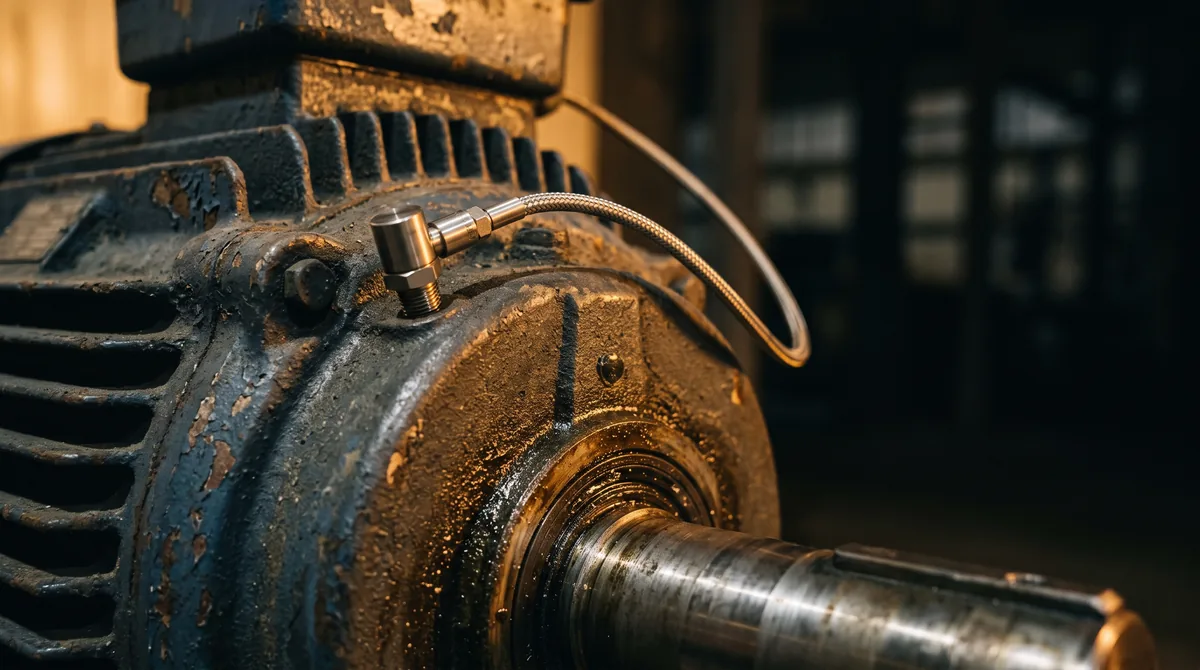
Close-up of an electric motor with a vibration sensor screwed onto the bearing housing and oil around the shaft.Wed 14:20 · deviationThis image was created with an AI tool (AI Act, Article 50).

Among Greek SMEs, 69% say they need predictive maintenance and only 3 to 4% use it. In basic and fabricated metals, AI use among firms with 10+ staff is 4.72% in Greece and 14.33% in the EU.

source (opens in a new tab)AI Readiness Index 2025 (ENTERSOFTONE, AUEB ELTRUN) A survey co-authored by a company that sells software. Useful, but not neutral.

Enterprises with 10+ staff. source (opens in a new tab)Eurostat, AI use by sector (isoc_eb_ain2), 2025 Figures from an official statistics body, with the year shown.

1234MonTueWedThuFriVibration (mm/s RMS)Wed 14:20 · deviationThu 06:00 · planned stopFri 22:40 · nothing
A typical example of what the model sees and does.

The invisible problem

Breakdowns aren't random. Nobody was listening.

Friday isn't to blame. The machine runs flat out all week, and on Friday night the technician who listens to it with a screwdriver to their ear has gone home. A bearing doesn't fail without warning. It heats up, vibrates, draws more current, days before. Nobody happens to be looking.

The stop costs more than the repair: lost output, Saturday overtime, a part sent by express courier, a late delivery to a customer who scores you on “on time, in full”.

Today's alternative is calendar maintenance: change the bearing every six months, whether it needs it or not. You pay twice. For parts thrown away half-used, and for failures that arrive before the calendar does.

Fri 22:40 · A2 · bearingFri 23:15 · P-3 · pump

How it works on your floor

It listens, understands, tells someone.

  1. 1 What you already have

    Sensors where it hurts

    Wireless vibration and temperature sensors on the 3–⁠5 machines that stop the line: motors, pumps, fans, gearboxes, compressors. Current transformers for the motor, plus whatever the PLC already records: pressure, oil temperature, running hours. The sensors fix on with a magnet or adhesive, no cabling.

    vibration · temperature · current · OPC UA · Modbus · MQTT

  2. 2 The model

    The model knows what healthy sounds like

    In the first weeks it learns each machine's normal signature, by load and by product. Then it looks for departures: vibration rising in mm/s RMS, frequencies that match bearing wear or misalignment, temperature climbing for no reason. It doesn't need a history of dozens of failures to get started.

    anomaly detection · vibration spectrum

  3. 3 The decision, inside your system

    A work order, not a siren

    When the departure persists, a draft work order opens in your maintenance system or ERP, with the chart, the likely cause and the part. Your maintenance lead decides when the machine stops, inside the production plan. Nothing shuts itself down.

    “Compressor A2, motor bearing: vibration 3.4 mm/s and rising, outer-race wear pattern. Suggested bearing change at the next shift change. In stock: yes.”

    An example alert, as it would reach your team.

    work order · ERP · maintenance system · Viber

Three-step diagram: sensors on a motor and pump, a chart where the live reading leaves the normal operating band, and a work order on a tablet with the likely cause and the part.

Hardware: vibration and temperature sensors and one gateway per area. Supplied and fitted by a hardware partner or the supplier you already trust. We take care of the data, the models, the dashboards and the alerts.

What we measure

Five numbers. None of them new.

This image was created with an AI tool (AI Act, Article 50).
Fig. 1 — A motor, a pump, a sensor on the bearing. It hears what the night shift can't.

Your maintenance lead already knows them, roughly. We measure them exactly, before and after.

  1. Unplanned downtime hours a month

    The formula Σ duration of stops that weren't scheduled

    We measure it in the baseline period. We don't show a number we haven't measured.
  2. MTBF · mean time between failures

    with / without the experienced technician on shift

    The formula running hours ÷ number of failures

    We measure it in the baseline period. We don't show a number we haven't measured.
  3. MTTR · mean time to repair

    with / without the experienced technician on shift

    The formula total repair time ÷ number of repairs

    We measure it in the baseline period. We don't show a number we haven't measured.
  4. Maintenance cost per tonne (or unit)

    The formula (labour + parts + outside contractors) ÷ tonnes produced

    We measure it in the baseline period. We don't show a number we haven't measured.
  5. Availability (the first term of OEE)

    The formula run time ÷ planned time · OEE = Availability × Performance × Quality

    We measure it in the baseline period. We don't show a number we haven't measured.

How the benefit is worked out

Benefit = downtime hours avoided × cost per downtime hour + calendar-based part changes no longer needed − running cost

Payback (months) = pilot cost ÷ (monthly benefit − monthly running cost)

Your cost per downtime hour is yours: lost margin, overtime, penalties, emergency freight. We work it out from your own figures, not from other markets' averages.

The pilot

8–⁠12 weeks. 3–⁠5 critical machines.

If the target isn't met, the report says so, with the same numbers we would have shown if it had been.

NTX-PL-PM8–⁠12 weeks

Pilot charter

Scope
We choose together the machines that stop the line when they stop, have no standby, and take expensive or slow-to-arrive parts.
Duration
8–⁠12 weeks
Phases
  1. Weeks 1–⁠2Machine criticality from the breakdown log, sensors fitted, PLC connected.
  2. Weeks 3–⁠6The model learns normal running. A dashboard for maintenance.
  3. Weeks 7–⁠12Live alerts and work orders. Measurement against the baseline. Decision.
Target
Example target: every confirmed departure (wear the technician found on opening the machine, a known fault, a controlled test) is caught before failure, with false alarms below the weekly limit your maintenance lead sets.1 An example target. Yours is set from your own baseline.
Cost
It starts with a Plant X-Ray, from €4,900, credited in full against the pilot.Sensors are priced separately.

Signed before any code is written.

1 In 12 weeks, nothing may break. So the target doesn't say “predict a failure”. It says what was caught, what was confirmed and how many alarms were false. Downtime hours are judged over a year.

Evidence

What the numbers say, and who's saying them.

  1. ≈2,000 hours

    of unplanned downtime and 53 process interruptions avoided over three years at steelmaker BlueScope, with predictive maintenance (Siemens, 2022).

    source (opens in a new tab)Siemens on BlueScope (2022) A figure published by a company that sells the solution. We show it, but with this label.

  2. 27 hours

    of unplanned downtime a month, on average, at a large plant.

    source (opens in a new tab)Siemens, True Cost of Downtime 2024 A figure published by a company that sells the solution. We show it, but with this label.

  3. −50% · −40%

    in unplanned downtime and maintenance cost respectively: Siemens' own claim for customers of its Senseye platform.

    source (opens in a new tab)Siemens, True Cost of Downtime 2024 A figure published by a company that sells the solution. We show it, but with this label.

  4. 69% · 3–⁠4%

    of Greek SMEs say they need predictive maintenance. Only 3–⁠4% use it.

    source (opens in a new tab)AI Readiness Index 2025 (ENTERSOFTONE, AUEB ELTRUN) A survey co-authored by a company that sells software. Useful, but not neutral.

Our own measured project

We haven't published a measured predictive-maintenance project yet. The first one could be in your plant.

Most of the numbers on this page come from vendors, and they are their best cases. We show them so you know the range, not as a promise.

Honest limits

It doesn't predict everything. We say so first.

Show one of the model's mistakes and how we handle it

One of its mistakes, in fullMonday 09:30A typical mistake of this kind, and how it is handled.

What the model said
The model said: “Conveyor C1 gearbox, vibration out of pattern.”
What actually happened
In fact the conveyor was running a new, heavier product at a higher speed. The machine was healthy.
What happened next
The maintenance lead tagged it “operating change”. The model now keeps a separate pattern for each product. The false alarm was counted in that week's report.

What it needs from you

  • Machines with moving parts and a steady running pattern: motors, pumps, fans, gearboxes, compressors.
  • The breakdown log, even if it's a notebook. We read it.
  • Access to the machines to fit sensors, under your safety rules.
  • A maintenance lead who answers the alerts. Without one, an alarm is just noise.

What it won't do

  • It can't predict failures that give no warning: electronics that die instantly, accidents, operator error.
  • It doesn't give a failure date to the day. It gives a warning and a window.
  • It doesn't scrap calendar maintenance overnight. It stretches it out where the data justifies it.
  • It doesn't touch the machine. It stops nothing on its own.

Play

The Glass Factory

One week, two endings.

A plant with five machines and data that runs live: one week in two minutes. Choose how it's maintained.

An example calculation for a typical plant. Your own figures come from the X-Ray.

Fully playable by keyboard.

Skip the demo: read how it works
  1. Wed 14:20 · Vibration leaves its pattern. Alert.

  2. Thu 06:00 · A 50-minute planned stop. Bearing from the shelf.

  3. Fri 22:40 · The line is running. The technician is asleep.

In the Glass Factory, a plant with five machines, vibration on a compressor bearing starts to climb on Wednesday afternoon. Without prediction, nobody sees it: the compressor stops on Friday at 22:40, the bearing isn't in stock, and line 2 restarts at Monday lunchtime. With predictive maintenance, the model gets one wrong first: on Monday it raises an alarm on a conveyor gearbox that was simply running a heavier product, and the maintenance lead logs it as false. On Wednesday afternoon it correctly flags the compressor, and the bearing is changed in a 50-minute planned stop on Thursday at 06:00. On Friday night the line runs normally.

What you just saw

Mechanism
Detecting departures from each machine's normal signature, with a warning before failure.
Why it works
Most mechanical failures give signs days in advance. The problem isn't that the signs aren't there. It's that nobody is looking at that moment.
Data it needs
Vibration, temperature and current from the critical machines; the breakdown log; the production plan.
Honest range
How many hours your plant saves depends on how often its machines fail and what each stop costs. We measure it over a year. We don't promise it in advance.

Same logic, another trade

Every trade has its own Friday night.

Same mechanism: sensors, a normal-running pattern, an alert with time to act. Six machines that can't afford to stop.

Use cases: the same mechanism at work in other trades.

Cotton gin, Karditsa

A season with no room for a lost day

What nobody sees
From October to January the gin stands, conveying fans and bale press run day and night. When a bearing goes, growers' lorries loaded with seed cotton wait in the yard, and the season doesn't stretch to make up for it.
What the AI does
Vibration and temperature sensors on the fan and gin-stand bearings, motor current on the bale press, an alert early enough to repair at shift change or when no deliveries are due.
What we'd measure
Downtime hours in season · lorries waiting · emergency repair cost

The scenario goes into the X-Ray form. Nothing goes into the page address.

Fish hatchery, Evia

The pump that stops at 4 a.m.

What nobody sees
The fry tanks live on their recirculation pumps and aeration blowers, day and night. If a motor stops at 4 a.m., the problem doesn't show at the machine. It shows in the tanks in the morning.
What the AI does
Vibration, temperature and current on the pumps and blowers, alongside dissolved oxygen in each tank; an alert with time to act, and a prompt to bring the standby pump online before the main one drops out.
What we'd measure
Hours with oxygen below the limit · motor failures at night · emergency technician call-outs

The scenario goes into the X-Ray form. Nothing goes into the page address.

Cold store, Larissa

The compressor that warms the frozen goods

What nobody sees
When a refrigeration compressor fails at night, the problem isn't the compressor. It's the customers' pallets warming up until someone notices in the morning.
What the AI does
Current, vibration and operating pressures on every compressor, wear prediction, an alert with time to act and a suggestion to spread the load across the remaining units.
What we'd measure
Hours outside the temperature limit · customer claims · emergency refrigeration call-outs

The scenario goes into the X-Ray form. Nothing goes into the page address.

Aggregates quarry, Magnesia

The crusher that sends the lorries back empty

What nobody sees
Crushers, screens and conveyors live in dust and vibration. When a screen bearing goes, production stops and customers' lorries leave empty.
What the AI does
Vibration and temperature sensors on screen and conveyor bearings, crusher motor current, an alert early enough to repair at the end of the shift.
What we'd measure
Downtime hours · tonnes per running hour · parts cost per tonne

The scenario goes into the X-Ray form. Nothing goes into the page address.

Steel mill, Almyros

The overhead crane that stops the whole bay

What nobody sees
When the overhead crane stops, it isn't one machine stopping. Everything waiting to be lifted stops too. Gearboxes, hoist motors and extraction fans work in dust and heat no maintenance calendar allows for.
What the AI does
Sensors on the gearboxes and hoist motors, PLC data, an alert that opens a work order for the next planned stop.
What we'd measure
Bay downtime hours · MTBF per crane · maintenance cost per tonne

The scenario goes into the X-Ray form. Nothing goes into the page address.

Solar park, Farsala

The inverter quietly producing less

What nobody sees
A string of dirty panels, or an inverter starting to overheat, raises no alarm. It just produces less, for months.
What the AI does
Every string and inverter compared with its neighbours and with irradiance, deviations flagged, cleaning or inspection suggested in order of priority.
What we'd measure
Performance ratio · MWh lost · time to intervention

The scenario goes into the X-Ray form. Nothing goes into the page address.

Questions

Do we need a failure history to start?

No. The model first learns how each machine runs when it's healthy and looks for departures from that, so it doesn't need dozens of recorded failures. The breakdown log, even a notebook, helps us choose the right machines and name the likely causes.

If nothing breaks during the pilot, how do we know it works?

That's why the target doesn't say “predict a failure”. It checks whether every confirmed departure was caught: wear the technician found on opening the machine, known faults, controlled tests. We count the false alarms too. Downtime hours are judged over a year, not twelve weeks.

Which machines are worth monitoring?

The ones that stop the line when they stop, have no standby, take expensive or slow parts, and have moving parts: motors, pumps, fans, gearboxes, compressors. We choose them together in the Plant X-Ray, from the breakdown log and a walk down the line. For the pilot, usually 3 to 5.

Do we need to buy sensors? Who fits them?

Yes, for machines that don't have them. Wireless vibration and temperature sensors fix on with a magnet or adhesive, with no cabling and no change to the machine. A hardware partner, or the supplier you already trust, provides and fits them. We take care of the data, the models and the alerts.

Does it connect to our ERP or maintenance system?

Yes. The alert opens a draft work order where you already work: in the ERP, a maintenance system or, if there isn't one, a simple list with a Viber message. 80% of Greek SMEs name ERP and CRM integration as a barrier to AI. That's why we design it from day one, not at the end. source (opens in a new tab)AI Readiness Index 2025 (ENTERSOFTONE, AUEB ELTRUN) A survey co-authored by a company that sells software. Useful, but not neutral.

What does it cost?

We start with a Plant X-Ray, from €4,900, credited in full against the pilot. Payback is worked out with your own cost per downtime hour.

Next step

Show us your breakdown log.

Even if it's a notebook with oil on the pages. In the Plant X-Ray we find the 3–⁠5 machines that ruin your Fridays, and what each one costs you.

  • From €4,900 · 10 working days at your plant
  • Credited in full against a pilot signed within 60 days.

We sit your plant's safety induction before we set foot on the line.