

- Mechanism
- Gm · Snackable game + Sv · Self-visualisation + Qr · Code as content
- Psychology
- We value what we earn with effort: the IKEA effect (Norton, Mochon & Ariely, 2012). And "17/20" works because the closer the goal, the harder it pulls (Kivetz, Urminsky & Zheng, 2006). Norton, Mochon & Ariely (2012), Journal of Consumer Psychology · Kivetz, Urminsky & Zheng (2006), Journal of Marketing Research
- Platform signal
- Friends film friends. Every set in front of the window is a Reel you didn't pay for, and the QR code walks people from the pavement to the front desk.
- Honest range
- 15–30% of people who claim the pass use it · 15–30% of those become members Typical range for a pilot in a Greek SME · Netex estimate
Strategy Lab · Gyms
Twenty squats. One free week. Do 20 Squats: a gym marketing idea where AI counts the reps

- The image never leaves your device
The demo didn't load. The description below tells you what you'd have seen.
The demo in words: the challenge is 20 clean squats in 40 seconds. If you allow the camera, a pose model finds 33 points of your body in every frame, inside your browser, and a counter judges every rep by the knee angle: only full squats, hips down to knee height, count; half squats get "Half squats don't count", and cues say "Chest up" or "Lower". Nothing is uploaded or stored. Without the camera, you hold a button or the Space key to squat and a drawn skeleton shows the movement; an example set shows it doing a full set. At the end you see your reps, your time and a form score; at 20/20 an example QR pass appears, and below 20 you see the ad that would invite you back to finish the set. With "No timer" there is no clock.
At a glanceGyms
How can a gym use an AI camera to win new members?
Do 20 Squats is a gym marketing mechanism: a passer-by does 20 squats at a window camera kiosk, an AI pose model checks depth and form on the device, and a QR code hands over a free week's pass. Typical range: 15–30% of claimed passes get used. Mechanism Sprint: 10 working days, from €1,500 plus production and hardware.
A Mechanism Sprint is how Netex builds one marketing mechanism like this: designed for your sector, produced and measured in 10 working days, with the automated replies to the messages it brings set up before launch.
Netex — digital engineering studio in Heraklion and the Almyros industrial area.
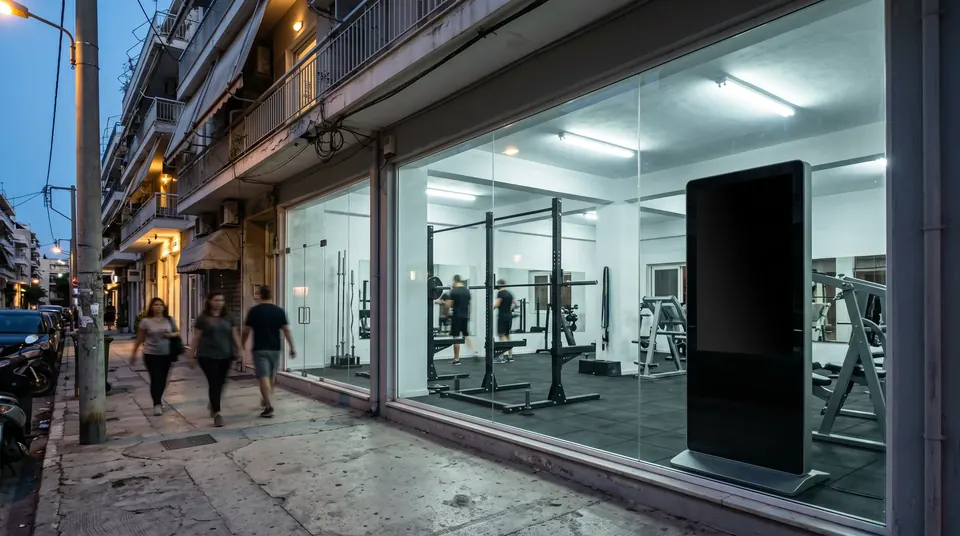
A kiosk with a camera in the gym's window. A passer-by does 20 squats, the AI checks depth and form, and a QR code hands them a week's pass. Try it here with your device's camera.
- Sector
- Gyms
- Mechanics
- A few minutes of play that is the value proposition itself.You see the result on you or in your home before you buy.The QR or code is the creative itself.
- Demo engine
- Sensor (camera, pose)
- Complexity
- 1 = configuring existing tools · 5 = custom R&D
- Production cost
- Netex production only, excluding media and data licences. € under €2,000 · €€ €2,000–6,000 · €€€ €6,000–15,000 · €€€€ €15,000–40,000 · €€€€€ over €40,000. Netex estimate.
Decode
How it got you
Deploy
How we'd build it for you
Who it's forFor gyms and studios with a window on a street, in a shopping centre or near a university.
-
A kiosk with a screen and camera in the window. A passer-by does 20 squats, the AI checks depth and form, and a QR code gives a seven-day pass.
-
The same game on the web, for Instagram traffic: "Can you do 20 clean squats in 40″? The AI is counting."
-
After the set, a form tip from your trainers. That builds authority, not just excitement.
-
A neighbourhood leaderboard: which neighbourhood does the cleanest sets this week.
-
People who didn't redeem see this the next day: "You did 17/20. Come and finish the set."
Channels and tech
- Channels
- Window kiosk · Instagram · pass delivered by Viber or WhatsApp
- Tech
- MediaPipe Pose Landmarker in the browser, a kiosk-mode screen with a camera, a QR code, a simple CRM table. No image goes to the cloud.
- Complexity
- 2–3/5
- Production cost
- €€ plus kiosk hardware · Netex estimate
What to expect, honestly
We don't promise viral. We promise a mechanism you can measure.
- People who claim the pass and use it 15–30%
- Of those, people who become members 15–30%
most likely on a first run · A first run usually lands in the lower half of the range.
Before launch we fix one primary KPI and a control: a holdout area, off-trigger days or the previous period.Guardrails
- The camera only opens on an explicit action, and the window says so on a sign.
- No images stored. The board keeps only a nickname, a neighbourhood and a score.
- It isn't medical advice. Form guidance comes from your trainers.
- Anyone walking past behind the player is neither recorded nor counted.
- Permission from the shopping centre or the municipality for a camera kiosk.
Who did it before us
We couldn't find a published gym campaign with exactly this mechanism. The closest relatives:
Third-party results are mostly self-reported, from award entries and vendors. They show a mechanic can work, not what it will do for you.
| Year | Who | What they did | Result |
|---|---|---|---|
| pre-2022 · international | Trolls World Tour · WebAR on the pack | Scanning the pack launched AR mini-games in the browser. | 60% of sessions lasted over 5 minutes |
| 2023 · US | McDonald's "Grimace's Birthday" | A free retro-style browser game for a mascot's birthday. | No numbers published; it became a cult object |
| 2022 · US | Coinbase "Bouncing QR" | A 60″ ad showing nothing but a bouncing QR code. | 20M+ visits in one minute |
From marketing to AI
The same eye, on a different job.
The AI that counts squats "sees": it finds points in an image and measures distances and angles. The same family of technology inspects parts on a production line, using cameras that are already there.
- Camera frame
- Points found: joints, or the edges of a part
- Angles and distances measured
- A rep counted, or a part passed
Questions about Do 20 Squats
Is the camera recording people?
No. The camera opens only on an explicit action, and a sign in the window says so. The pose model runs on the device, no image is stored or sent to the cloud, and anyone walking past behind the player is neither recorded nor counted. The board keeps only a nickname, a neighbourhood and a score.
How does the AI know a squat is clean?
A pose model finds 33 points of the body in every frame, inside the browser, and the counter judges each rep by the knee angle. Only full squats, hips down to knee height, count; half squats don't. After the set, the tip on form comes from your own trainers.
What does the gym need for it?
A screen with a camera in a street-facing window, in a shopping centre or near a university, permission from the centre or the municipality for a camera kiosk, and a simple CRM table for passes. The same game also runs on the web for Instagram traffic, and passes go out by Viber or WhatsApp.
What results can a gym expect?
We don't promise viral. The typical range, a Netex estimate for a pilot, is 15–30% of people who claim the pass using it, and 15–30% of those becoming members. People who didn't redeem see a nudge the next day: "You did 17/20. Come and finish the set."
How long does it take, and what does it cost?
As a Mechanism Sprint it is designed, produced and measured in 10 working days, from €1,500 plus production and hardware. Production is in the €€ tier, €2,000 to €6,000 by Netex estimate, plus the kiosk's screen and camera. Complexity is 2–3 of 5.
Mechanism Sprint
What would a passer-by do to earn your pass?
Mechanism Sprint: designed, produced and measured in 10 working days. From €1,500 plus production and hardware.
The scenario you just played goes straight into the form.

